
And What to Do About It
You’re juggling a full workday, picking up the kids, and still finding time for your Saturday pickleball or tennis match. You’re active. You’re doing the things. And yet—your knee has been nagging you for months. Your low back tightens up every time you sit down at your desk for too long. Your shoulder aches when you serve, but you play through it anyway because who has time to stop?
Sound familiar? If you’re over 40 and juggling a career, a family, and trying to stay active, you’ve probably told yourself the same story everyone tells themselves: “this is just what getting older feels like.”
Here’s the truth: getting older sucks sometimes. We’re not going to sugarcoat that. But here’s the bigger truth—aging isn’t actually the reason you’re in pain. The real reason is how you’re aging. It’s not about doing too much. It’s about doing things with movement patterns that were never corrected, strength gaps that were never addressed, and dysfunctions that have been quietly running the show in the background of every rep, every step, and every swing you take.
We Treat the Symptom, Not the System
When something starts to hurt, most of us follow the same playbook. We go to the doctor. We book a PT session. We hire a trainer. And in almost every case, the focus lands squarely on where it hurts—not on what’s actually causing it.
And when the pain flares up, we default to one of a few options: rest completely, reach for pain medication, wait it out and hope it resolves on its own, or—the option a lot of weekend athletes choose—just keep playing and push through it.
None of these get to the real problem. What we should be looking at instead is the full system: strength imbalances, mobility restrictions, and compensation patterns that have been building for years. The goal shouldn’t just be pain relief. It should be restoring how your body is supposed to move in the first place.
And I’ll be the bearer of bad news here: we’re not going to fix a problem that took years to build in 24 hours, or even a week. But it’s worth investing a month, a few months, even a year, to get you to the kind of long-term durability and freedom from pain that lets you actually live the life you want.
Why This Keeps Getting Missed
We’re all smart people. We do the “right” things—we go to our annual doctor visits, we show up to group fitness classes, we stay active. But here’s the problem: those visits and those classes usually aren’t built to assess you and your individual movement patterns. They’re built for the general population, not for the specific way your body compensates and moves.
So we default to the easiest explanation available: “I’m just getting older.” And getting older does come with real changes—we’re not denying that. But so many of the people we talk to describe the exact same pattern: “I can only have one thing hurting at a time.” One thing calms down, and something else flares up. You’re always waiting to see where the next ball is going to drop, and you get up most mornings with something bothering you.
It doesn’t have to be that way. But changing it takes more time and focus on your body than most of us are used to giving it. We do a lot of active things—but not nearly enough restorative and corrective work to match.
What’s Actually Going On: Compensation Patterns
Here’s a pattern we see constantly. Someone shifts their weight onto one hip more than the other—something that starts as a habit, not an injury. Over time, that shift changes how pressure loads into the knee. Weakness shows up in the feet. The arches start to collapse. That adds even more stress traveling up the chain into the knee. Meanwhile, the glutes aren’t firing the way they should, and pain starts showing up in the low back. When you walk, run, or play, your body isn’t absorbing ground contact the way it’s designed to—so instead of dissipating that force, you’re left absorbing more pain.
One small, unaddressed compensation pattern can quietly reroute stress through your entire body.
As we age, flexibility gets a lot of attention—and it matters. But what gets overlooked far more often is declining strength and power. We tell ourselves certain movements are “off the table” because we’re older. The truth is usually simpler and more encouraging: you stopped doing them, not because you had to, but because you did. And your body adapts to what you consistently ask of it. Keep asking it to be strong and capable, and it will keep responding.
This is exactly what ties back to independence and longevity for anyone 50 and beyond. Your body cares about how well you move and how resilient your muscles stay—and that resilience is trainable for as long as you keep training it.
What to Do About It
Get a Real Movement Assessment
When you sit down with a doctor, a PT, or a trainer, push past a conversation about just the painful spot. A real assessment looks at the pattern driving the pain—not just where you feel it.
Build Strength in the Right Places
More often than not, the site of the pain isn’t the site of the problem. Something else in the chain—weak glutes, unstable feet, a stiff hip—is usually the real driver. It’s worth stepping back and looking at the bigger picture instead of only the local symptom.
Work With Professionals Who Talk to Each Other
It’s okay—and important—to bring in more than one professional. What matters most is that they collaborate. Here at Nesfield Performance, we’re grateful to partner with Elevated Strength & Rehab, so our clients get coordinated care between physical therapy and performance coaching under one roof. That kind of communication between providers is what produces real, lasting results.
Commit to Consistency, Not a Single Session
One of the biggest mistakes we see is someone coming in for a single session and expecting everything to be fixed. Real results come from consistency. Sporadic effort doesn’t create lasting change—steady, focused work does.
Ready to Get Started? Here’s Your July Offer
If you’re ready to stop guessing and get a real answer for what’s driving your pain, this month is the time to start.
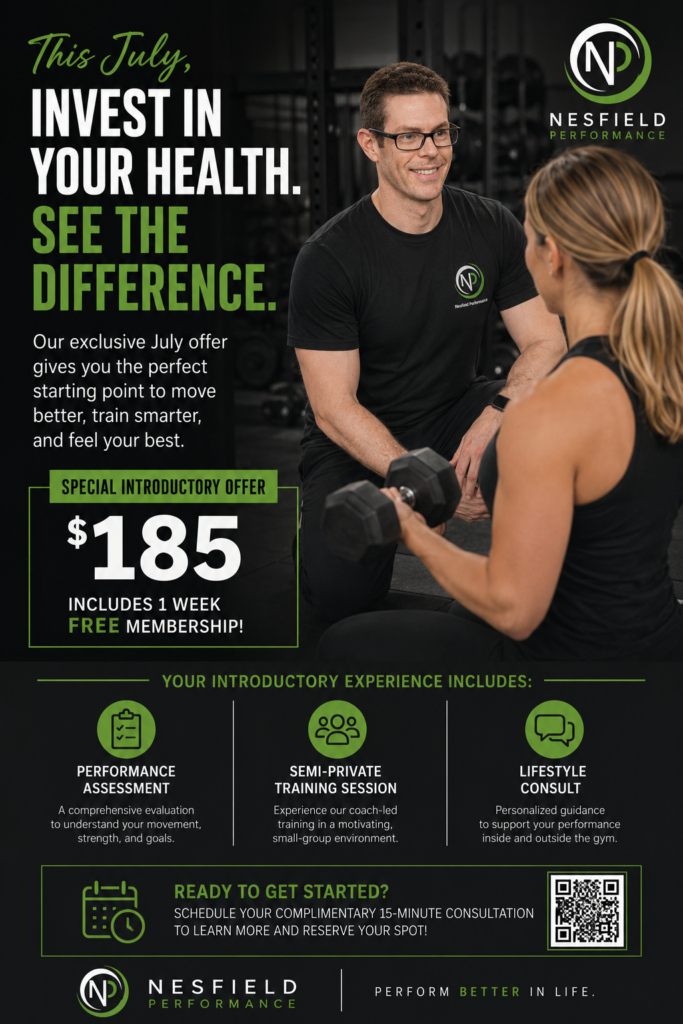
Nesfield Performance: $185 Performance Start Plan
Our July offer is built to get you moving in the right direction with a real assessment first—not a guess. For $185, you get:
- Performance Assessment
- Semi-Private Training Session
- Lifestyle Consult
- Plus 1 Week FREE Membership
Spots are limited, and this offer ends July 31st. Learn more and register here!
Elevated Strength & Rehab: 4th of July Flash Sale
Our on-site PT partner, Elevated Strength & Rehab, is also running a limited-time 4th of July offer—“Declare Independence from Pain”—so you can get back to the golf course, the boat, or whatever makes your summer worth living. Their freedom package includes:
- $99 Evaluations (new patients)
- $99 Re-Entry Session (normally much more)
- 15% Off All Packages
- Free Consult Call for new patients — no pressure, no surprises
This offer ends July 4th, so don’t miss the window. Sign up here!
The Bottom Line
Pain isn’t the price of admission for staying active as you age. It’s usually a signal that somewhere in your system, a movement pattern, a strength gap, or a compensation you’ve been living with needs real attention—not just a quick fix for wherever it hurts today.
At Nesfield Performance in Bethesda, we start with an honest look at how you move, not just where you hurt. Combined with our on-site partnership with Elevated Strength & Rehab, we help active adults across Bethesda, Chevy Chase, and the surrounding DC suburbs build the strength, mobility, and movement quality to stay independent, capable, and pain-free for the long run.
Ready to find out what’s actually driving your pain? Take advantage of our $185 Performance Start Plan this July and get a real answer, not a guess.